ISS astronaut will conduct Canada's 1st spacewalk in 7 years on Oct. 29: Watch it live
The next International Space Station (ISS) spacewalk will have more maple-leaf flavor than usual, as a Canadian astronaut will become the first to go outside the orbiting complex in seven years.
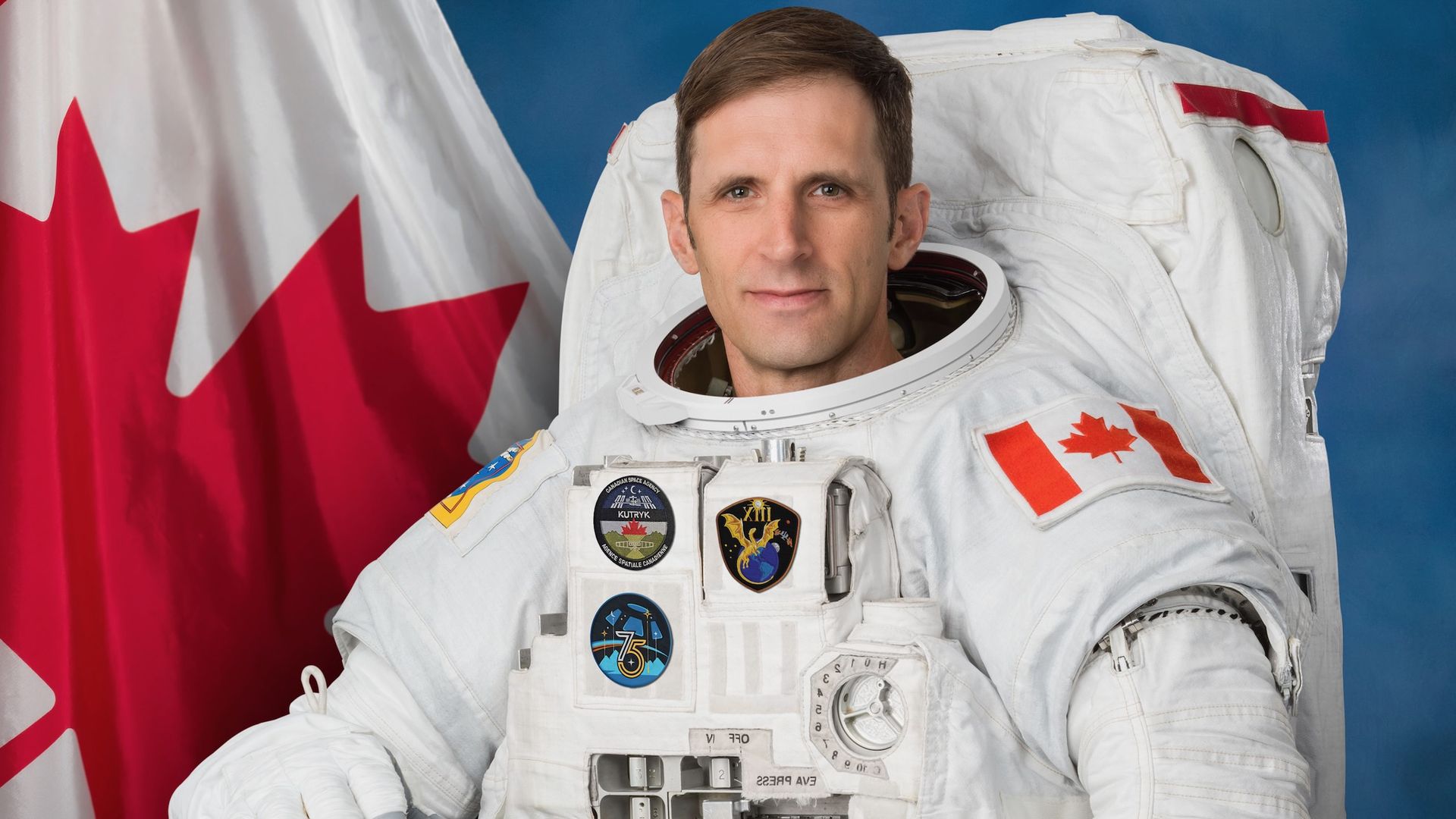
Canadian Space Agency (CSA) astronaut Joshua Kutryk, who's also a colonel in the Royal Canadian Air Force, will help the ISS boost its power supply during his first-ever spacewalk on Thursday (Oct. 29). Kutryk will be joined by NASA astronaut Anil Menon, who has done three spacewalks already and also serves as a colonel with the U.S. Space Force.
The duo are scheduled to venture outside the orbiting lab at 8 a.m. EDT (1200 GMT), kicking off a spacewalk that will last roughly 6 hours and 45 minutes. You can watch it live here at Space.com, courtesy of NASA, beginning at 6:30 a.m. EDT (1030 GMT).
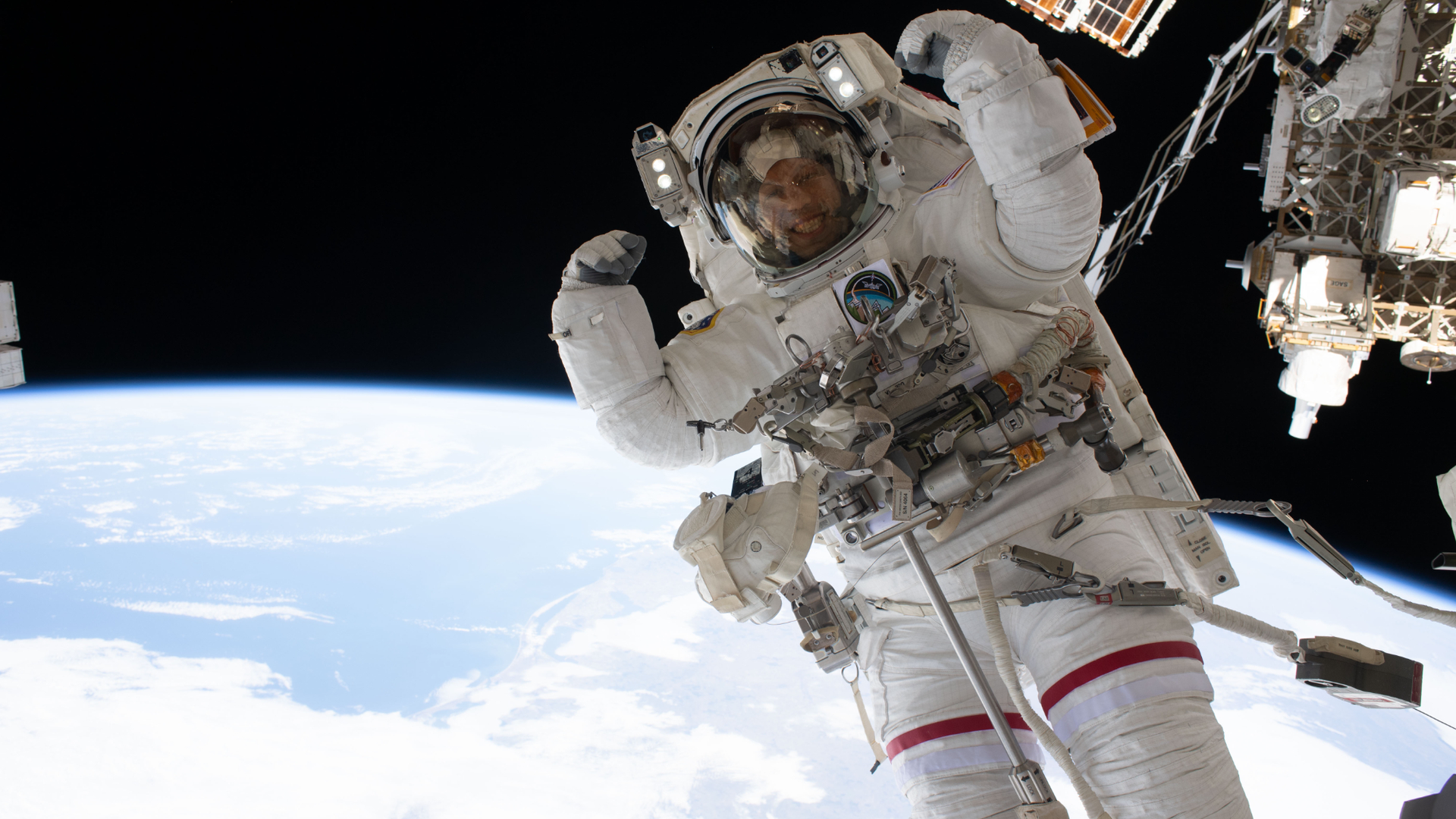
It will be the first of two extravehicular activities (EVAs) for Menon and Kutryk, with the second expected to occur no sooner than Nov. 5. During the two spacewalks, the astronauts will deploy the seventh and eighth International Space Station Roll-Out Solar Arrays (iROSAs).
iROSAs lie on top of the existing, decades-old arrays on ISS, which are naturally degrading with age. The first iROSA rolled out in 2021. Once all eight are installed and running, the station will see its power supply rise from 160 kilowatts to about 215 kilowatts — a boost of roughly 30%.
A Canadian capcom, too
The capcom (capsule communicator) for both spacewalks will be CSA astronaut Jenni Gibbons. She has experience in this role already, serving as a capcom on NASA's Artemis II mission around the moon this past April. And she'll serve as lead capcom for Artemis III, which will test crewed lunar landers in Earth orbit next summer, if all goes to plan.
Also helping Kutryk and Menon will be Canadian space technology, specifically Canadarm2 — the ISS robotic arm tasked for spacewalk support, among other maintenance duties.
"It's been busy preparing for the upcoming spacewalks," Menon said about Canadarm2 in a Saturday (Oct. 24) X post. Ground controllers recently moved the arm over to the "trunk" or storage area of a SpaceX Dragon cargo spacecraft, which brought the two iROSA arrays up earlier this month.Canadarm2 picked up the IROSAs and moved them to a transporter for the astronauts. "It even loosened bolts for us before the spacewalks … I'm grateful for the help," Menon added.
During the Oct. 29 spacewalk, Canadarm2 will do even more. Kutryk and Menon will slide an array off its transport rail and then have Menon get onto a Canadarm2 platform, to put the array into his hands. From inside the ISS, NASA astronauts Luke Delaney and Jessica Watkins will carefully move Canadarm2 to put Menon and the array at the ISS port-installation site, supporting the 2A electrical-power channel.
Each array is about 10 feet (3 meters) long when folded up and weighs 750 pounds (340 kilograms) here on Earth, according to Garrett Hehn, NASA's spacewalk flight director. The agency therefore knows the iROSAs are "a lot to handle," he said during a press conference on Oct. 20 that previewed the two upcoming spacewalks.
As such, NASA looked at how previous iROSA spacewalks were performed and created a new "elegant series of maneuvers, where we've tried to rotate around the actual center of mass of the arrays, rather than the crew member," Hehn added. "It was a lesson learned from previous EVAs, of how we thought we could make it a little less tiring on Anil."
Kutryk will move over to the installation location, hand-over-hand, to join Menon. There, the two will place the IROSA onto the older solar array, using a "mod kit" placed on a previous spacewalk. "We've got a series of bolts to structurally attach it [the IROSA] and release, in order for this folded-up configuration to fold open, and basically go from about 10 feet long to around 20 feet [6 m] long," Hehn explained.
"These arrays," he added, "I kind of think of them like a snap bracelet … They basically have a series of magnets up the side, where they deploy with enough energy that it just continues rolling out steadily. That process will take about 10 minutes on the day of the EVA."
Following that, the astronauts need to access power cables at a time when that area of the ISS is not in sunlight; the station will be (as always) moving through its orbit, circling the Earth every 90 minutes, so timing will be important.
"We can't have any sun on the arrays, whenever we're handling those hot cables," Hehn said. "Basically, we'll use a jumper to bring together both the legacy arrays' power, and this new rollout solar arrays' power, in order to have a pretty substantial gain to our power-generation capability."
The Nov. 5 EVA will essentially have the astronauts do the same installation procedure with another array, this time heading to the starboard side of the space station. The last IROSA installation, however, will take place a little farther from the station, beyond Canadarm2's reach. So the astronauts will do a "leapfrog" to get out there.
After Menon, the array and Canadarm2 are brought to the installation location, Hehn said, Kutryk — moving to the same location by himself, hand over hand — will go into another platform installed on the station truss, and take the IROSA from Menon's hands. As Kutryk waits in place, Menon will exit the robotics platform, move it from the Canadarm2 to another spot on the space station's truss, and then get back on to the platform to hold the IROSA securely for installation for the 3B electrical-power channel.
"This is the way that we close that final distance that the robotic arm is unable to do on its own," Hehn said.
Canadian robots, support teams — and new funding
The CSA's last spacewalk was during the agency's previous mission seven years ago, which involved astronaut David Saint-Jacques. On April 8, 2019, Saint-Jacques successfully fought difficult equipment during a busy excursion alongside NASA astronaut Anne McClain.
CSA has a 2.3% contribution to ISS, usually working out to a flight every five or six years. However, Kutryk's slot was delayed two years, from 2024 to 2026, because he was originally assigned to fly up on Boeing's Starliner capsule, which needs more flight testing following numerous issues that cropped up during its crewed demonstration flight in 2024.
Kutryk, who launched Oct. 1 aboard a SpaceX Crew Dragon with three other astronauts, has generated a lot of political and industry excitement in Canada. His mission marks a rare pair of CSA astronaut launches in a single year, as Artemis II astronaut Jeremy Hansen just launched in April. (The last time this happened was in 2009, when Robert Thirsk was doing a long-duration station excursion and Julie Payette visited during a two-week space shuttle mission.)
Canadian astronaut missions are unusual, even when including private missions — or non-CSA government astronauts, like now-retired NASA astronaut Andrew Feustel, who has dual U.S.-Canadian citizenship. Canada is therefore using the new CSA mission as a catalyst. In recent weeks, Canada announced several government and industry commitments to keep the momentum going even after Kutryk returns next spring.
For example, Canada just announced its first bipartisan space caucus, named Hansen a space advisor to the prime minister, pledged to soon give CSA its first space strategy since 2019, and promised, if at all possible, to announce a mission assignment for Gibbons within the next year. (The latter may depend on factors such as NASA's availability for missions, as Canada does not launch astronauts on its own.)
On the industry side, Canada's defense department last week promised the launch company NordSpace $20 million CDN ($14 million USD) for a 10-year launch pad access agreement at the company's young spaceport in the province Newfoundland and Labrador; additional mission costs will be paid when those are ordered. Canada also recently promised $200 million CDN ($140 million USD) to Maritime Launch Services over 10 years, committing to a launch pad at the company's emerging spaceport in Nova Scotia.
from Latest from Space.com https://ift.tt/FpJ3mVg
Comments
Post a Comment